Showing posts with label Regency. Show all posts

Aug 17, 2016

Online exhibition - invitation to be involved

At Jane Austen Festival Australia in April 2017 I'll be putting on an exhibition of antique men's and women's Georgian & Regency clothes (a minimum of 20 items). Soon afterwards I hope to launch it as an online exhibition - and that's where I'd like to invite you to be involved in making it bigger and better. Do you collect clothing or accessories from this period? Would you like your items to be part of a global online exhibition? Or do you have computer time and skills you'd like to share helping to get this collection online? Would you like to be able to access a collection where you can click on an image to see close-up interior construction shots? If there is damage a link to conservation methods for repair or storage? Would you like to see links to similar garments online and patterns or books that could be used to make them? Maybe even an online calendar listing events around the world you could wear them to? Can you help write a draft crowdfunding proposal to help cover some of the costs of this project and to self-publish a colour book of the online exhibition?

I'm making a start on this in the next 7-10 days and welcome your support and ideas.

These 1770-90 glazed wool (Calimanco) shoes will be part of the exhibition

Mar 19, 2015

Midshipman Project

I have a lot of work on my plate, so finding time to write down much at all is very difficult. Instead I'm posting pictures of my inspiration and progress.


Dec 21, 2014

Blue Regency Ball Gown

I finished my blue regency silk satin and lace gown just in time to wear it to our Christmas Carol Ball last night. The simple dress theme was "Christmas" so John and I went as merrymakers from Mr Fezziwig's Party.


Nov 16, 2014

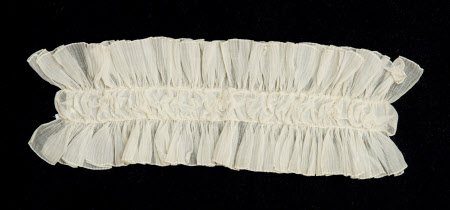
Regency Neck Ruffs

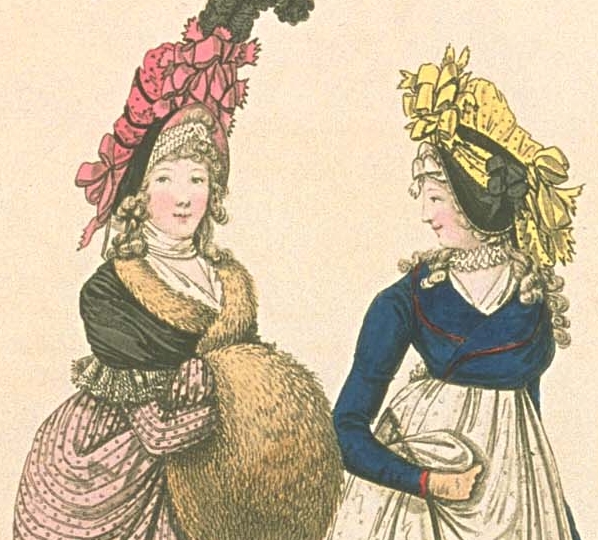
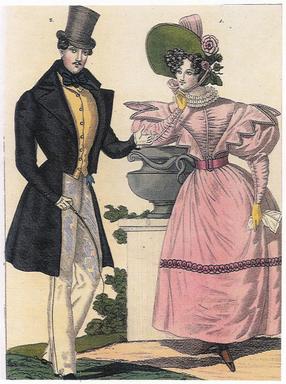
Regency-era neck ruffs are also called lace ruffs or frills; neck frills; double frills of worked muslin; fraise; cherusse and betsies. 


...Petticoat of worked muslin...Spencer of dark blue cloth, edged with scarlet. Ruff of white lace round the neck. Plain muslin handkerchief. York tan gloves.

March 1794, Gallery of Fashion. Morning dress

Lady Elgin wearing a fraise over a chemisette, 1804, by François Gérard

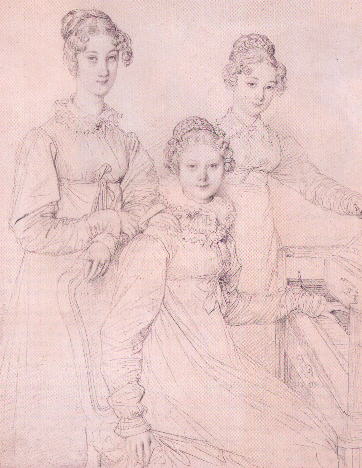
Countess Therese Czernin (1798-1896), drawn in 1819

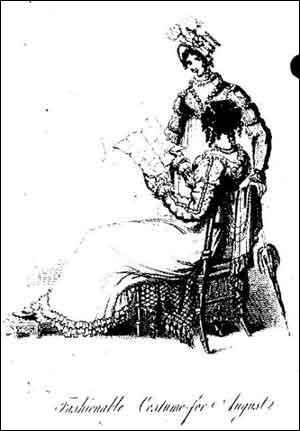
Walking Dress: Ladies' Monthly Museum, August 1815:
Robe of Jaconet Muslin or Fine Cambric, made high in the neck; the back and sleeves made very full; a double Frill of worked muslin round the neck; bottom of the robe to correspond”

Christoffer Wilhelm Eckersberg (2 January 1783 – 22 July 1853)
Portrait of Anna Maria Magnani
Oil on canvas, 1814 31 × 22 cm
The Hirschsprung Collection, Art museum, Copenhagen, Denmark


Fiche-guimpe, 1810
My Sewing Experiments

This was a neck ruff that I taught for a Regency Neck Ruff workshop at Jane Austen Festival Australia in April 2012. I used a sturdy cotton and did not teach whip stitch gathering as shown in examples below because we only had a short time to teach the fundamentals and get everyone sewing. In 2015 I'm hoping to teach a more involved workshop with whipstitch gathering and fine muslin.


Extant Examples

Since this workshop I have found more extant examples to base my work on. There is a neck frill documented in Nancy Bradfield's Costume in Detail, page 83.

National Trust Inventory Number 1350308

This one has a linen centre and a tiny bobbin lace decoration, ‘typical of the trimming laces of the very early19th Century’ The Lace Mentor. Found at http://www.poppiescottage.com/products-page/the-accessories-department/


Apr 30, 2012

Regency Costume Challenge May 2012 - March 2013

Our Regency Costume Challenge starts tomorrow and its not too late to join us - international entries are welcome. 
Click on the photos to see who is entering on the information page at http://earthlydelights.com.au/janeaustenfestival/costume


Feb 6, 2012

Regency Spencer

I love this little silk spencer with its embroidered flowers - and being able to find a cotton velvet to match made it extra special.
My main difficulty with this project was the embroidered flowers - they were very thick and caused havoc in seams. 
I used the Sensibility Spencer Pattern - and would recommend it to others for its ease in making.

I have the bonnet, now I need to make a spencer.


Dec 30, 2011

Regency Chemisette

Today I started on the underpinnings for a new project for a client - a full regency wardrobe. It includes a chemise, pantalettes, stays, petticoat, chemisette, day dress, spencer, open robe, ball gown, reticule and bonnet. Yes, this is the project with the KCI-inspired ball gown.
I'm rather pleased with the chemisette. It is mostly hand stitched - a necessity with the very sheer linen as it kept wanting to move around. I had more control over it by hand stitching. When I finished I couldn't see the stitches!


You can make your own copy of this chemisette by using the Sensibility Undergarments Pattern.


Chemisette, c.1800 Killerton House UK
http://www.nationaltrustcollections.org.uk/object/1360127


Dec 3, 2011

Making a Close Bonnet of c.1810

For bonnet-making enthusiasts, Your Wardrobe Unlock'd has just uploaded a how-to make an 1810s Closed Bonnet article by Serena Dyer.

Your Wardrone Unlockd is a membership based website that I already subscribe to and enjoy the many articles already there and to come. There are one, three, six and twelve month memberships to suit all budgets, and this year the offers are better than ever - three months for the price of two, or HALF PRICE for six and twelve month packages!


May 11, 2011

Men's Regency Tailcoat Workshop, 21-22 May 2011

Aylwen Gardiner-Garden is running a one-off men's regency tailcoat workshop on the 21-22 May 2011 in Canberra, Australia, using the Country Wives brand new Regency men's M-notch and roll collar tailcoat pattern that has just been released in the US and which is already receiving good reviews on its fit, historical accuracy and construction techniques.
Country Wives has just released a brand new Regency men's M-notch and roll collar tailcoat pattern.
This workshop is open to both men and women who have sewing experience, a working sewing machine and time to get the project finished. Participants are welcome to sew the project by hand as was done historically, but may have to finish it in their own time.

If you wish to order a custom-made tailcoat or register interest in a future class, Aylwen is currently taking orders.


Feb 11, 2011

Regency Petticoats

This entry will be a continuing work in progress. Our Jane Austen Festival is coming up in April and I'm seeing many writing about their new dresses. Below are some ideas on petticoats that you can make to wear underneath. Generally, you wear a shift, stays, petticoat and then the gown. You would not want your stays to show through the fine muslin fabrics.

If you wish to make a petticoat using a modern pattern the Sensibility regency patterns offer a petticoat option.

This petticoat is available for viewing through the Met Museum's online database.

Front
Back

Petticoatearly 19th centuryAmericanlinen[no dimensions available]Gift of Mrs. George Nichols, 1964C.I.64.26.3
Not on View.

May 23, 2009

Night Clothes

Regency Night-Dress (1)
This garment is worn at night instead of the day shift in the cooler months. It features:
  • long sleeves with narrow trimmed cuffs
  • slit in the front fastened with three buttons equally spaced.
  • buttonholes are lengthways on the narrow hem.
  • trimmed collar that is either turned down or standing like a fichu
  • shoulder pieces
If the night-dress is figure-hugging, wear a muslin fichu made of "a square of four quarters of middling-quality muslin, which you fold like a shawl".
In summer a nightcap without strings is worn, in winter a trimmed serre-tête is worn underneath a cap with strings.
In hot weather the day shift might be worn with a muslin fichu that is replaced by a night jacket.


1. Grimble, Frances, The Lady's Stratagem, pg 183-4.

Dec 23, 2008

Regency Seams


Looking closely at the side back and shoulder seams you can see that they have not been sewn together in the manner you might see 18th century garments, particularly frock coats. In these garments you see a two layers (fashion fabric and lining) sewn face to face with a piece of fashion fabric, then the seam is ironed towards the single piece of fabric. Over this seam and single piece of fabric is laid a piece of lining, the seams tucked under and then whip-stitched to the existing seam.


I'll have to do a little demo on how I think this seam is done, but essentially I have the two fashion fabric layers together in the middle, with the two lining layers on each side. You sew from side to side, only three layers sewn each time. Its very complicated to describe but easy to do.

[Edited on 24/12/2013 - I've just found an excellent demo at http://stay-ingalive.blogspot.de/2011/03/how-to-do-weird-running-whip-stitch.html ]

This is an example I made (my blue regency dress made from a silk sari)

Dec 22, 2008

Regency Seams

Clothing construction methods were different in regency times. They did not have overlockers or sewing machines - it was done by hand. Fabric was very expensive and less plentiful, making frugality a necessity. Garments were fitted to the body and not sewn together from patterns.

Today we sew seams together by machine, right sides together with seam allowances of 1.5cm. The seams are then ironed, graded, notched or clipped to lie flat when turned, then ironed again. In regency garments in our collection the seams are narrow and outside seams are carefully finished to enclose all edges.

Bag-lining is very popular today, with lining pieces cut from a pattern, sewn together to make a garment, and then inserted into the garment towards the end of construction. In the garment below the fabric and lining have been treated as one during construction. Each piece has its lining attached to it before it is added to the next piece of fabric.

The construction methods and pattern style of these two dresses from England is very similar to an embroidered muslin dress in the Snowshill Collection c.1810 featured in Costume in Detail by Nancy Bradfield. The sleeves are very long, they feature apron-front bodices pinned at the shoulder. Both have white linen lining, the silk dress has tiny sleeves under the long sleeves and both feature narrow under-pieces at the front. Both have decorated bodices.


These photos show the side back and shoulder seams, together with the raw edges of the armscye seams inside a silk dress in our collection. In my next blog I will show how this method is done with step by step photos.


This shows the inside of a cotton dress in our collection.


This photo shows the lining of the front bodice and where the silk finishes.


Above are the finished seams of the front opening which are pinned closed underneath the bib front.

Seams joining the front skirt with the bib front. Shown here are the inside seams.

Jan 22, 2007

Our Midsummer Nights Dream Ball was a success! Even though temperatures were higher than expected, lots of people came and had a lovely time. I haven't downloaded the photos yet, but when I do they will be on our Photo Page. The renaissance dances we did were really fun - just like dances must have been danced at the time of Shakespeare, and the band Earthly Delights was great, right in the groove. Our next ball is a Jane Austen/Napoleonic Ball on the 17th February.

Today I started sewing a quilt for the first time in my life! I've been reading about other people starting them and a friend at work is halfway through one, so I've got one of my own to work on at lunch times and on the bus. I've chosen to do a Sweet Valentine BOM Quilt, designed by Lesley at Faeries in My Garden.

Last night I started another Regency ball gown for myself, using some brown silk dupion. I'm using the Sense & Sensibility Regency Dress pattern neckline supplement, choosing the sloping neckline option, but retaining the original low neckline. I've added 10" extra on the fold to the front to pleat up - it looks lovely when pleated up, attached to the linen lining and folded over. I've got to sew in a casing for a drawstring cord so it can be fitted over my shoulders. I'm planning to make an overdress, similar to one worn in the Sense & Sensibility movie.


My daughter Amy is cutting out a new dress that will look like Jane's white ball dress from Pride and Prejudice 2005. To make this gown, simply use the Sensibility pattern, An Elegant Ladies Closet. I will be selling these from next week on my patterns page.

Jan 19, 2007

Greetings all!

Its here at last! I've spent the last few weeks preparing for our Midsummer Nights Dream Ball - and its on this Saturday night 20 January 2007. The weather here is unbearably hot - so it's a night for cooler costumes - sprite-like ones! This morning the weatherman predicted 35 degrees C (95 degrees F). See what happens.

John has been teaching us new dances from his upcoming book focusing on new translations from Italian dance manuals. I'm finding all this very interesting but am glad to leave him to the research and teaching while I do the sewing.

I'm working on a set of Regency short stays this week. They're going together really fast. I really must recommend this pattern. I'll be selling the new stays pattern through Regency Reproductions from next week, along with some new patterns from Tailors Guide. I'm getting quite excited about the patterns - I'll be adding Regency-era patterns from Past Patterns and Wingeo in the next few months.


$0 Web Hosting

Total Page Views