Showing posts with label Tidens Tøj. Show all posts

Feb 7, 2017

My Tidens Tøj Regency Gown (updated)

Original Gown

This Danish wedding gown has long been of interest to me, and this week I received the fabric that I'd had custom embroidered for it. The original can be seen at http://natmus.dk/historisk-viden/temaer/modens-historie/1790-1840/hvid-brudekjole/.

My version of the embroidery pattern

Closer up of fabric with white embroidery along the hem.

I've chosen a fine white cotton with matching thread for embroidery and will be making a size 12 using the pattern below, which is a screenshot of the pdf that is back online at http://natmus.dk/fileadmin/user_upload/natmus/historisk-viden/modens-historie/snitmoenster/hvid-brudekjole.pdf.


Below are the photos I took of this gown on my recent trip to Denmark. It was so fantastic to see it up close, right in front of me. Unfortunately, it was behind glass, so these are the best photos I could get.


Patterns you may wish to use to replicate this gown include:
  • Nehelenia's 1790 Chemise Dress Pattern (based on this exact gown) gives a good bodice base and overlay.
  • Sense & Sensibilities Elegant Ladies Closet Pattern is good to use for dress construction methods as this gown is constructed like the drawstring gown. I used the skirt pattern but adjusted the fabric widths to fit my gown - my front pieces were wider and I used 2.5m for the back panel. Another pattern you could try that I did not experiment with is the Laughing Moon Chemise Dress, but it does not have the pleated collar overlay and I am unsure how the front is gathered.
My recommendation for beginners/intermediate is to make the Sensibility drawstring gown with elbow length sleeves and add the overlay from the Chemise dress pattern.  It's not quite what I did but would probably end being a lot easier.

Dress Base:
I put together two of these from sturdy linen for the boned bodice
and one from fine linen for the lining. 

The bodice is boned with cotton cord.

The back is pleated over the top of the boned bodice.

Laced at the front.
Eyelets are sewn by hand using a thick linen thread
from Burnley & Trowbridge.

Back view of laced bodice.

Bodice Overlay:

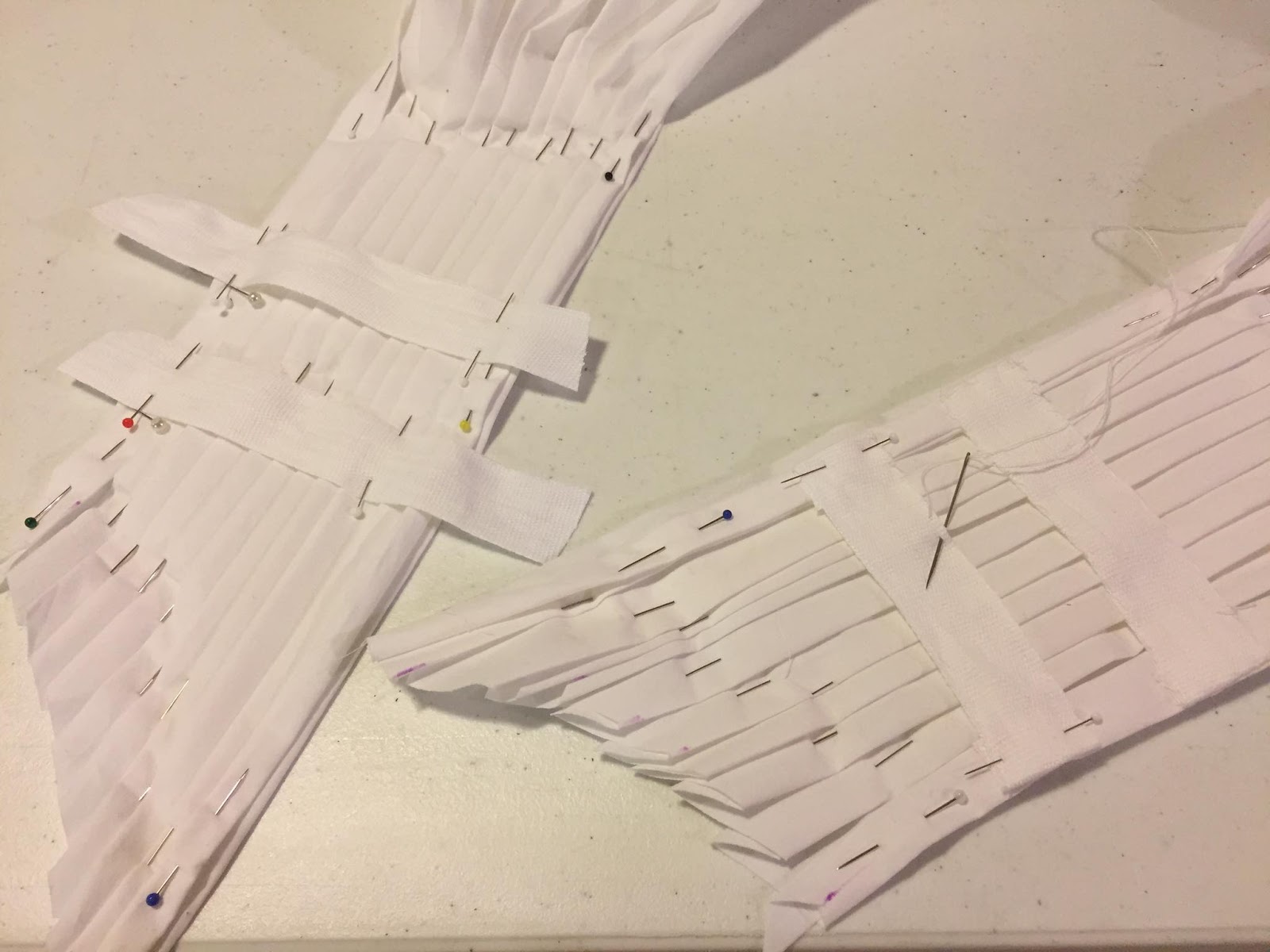
Pleated overlay with cotton stay tape as mentioned in the pattern instructions.

According to the instructions the ends are mounted onto cotton stay tape.

Tape pinned for sewing down.

Once the tapes are sewn down the back is sewn together by hand. 

Overlay is attached to the front skirt panel.
I made a french seam for tidiness and then ran a cotton tape through the casing.
Don't forget to sew the ends into the side seam before you finish constructing the gown.


Pleating the back and finishing off the gown:

2.5m fabric pleated onto the back.
Using 2" pleated I make a pleat facing towards center back,
pin it, then measure 1", stick in pin, and do next pleat to that pin. 

Starting to look like a dress at last!

3am selfie after sewing all night to get it finished. 

Front view with proper camera - must check my son's camera
settings because my iphone photos ended up a lot better than this.

Back view.
My husband wouldn't take the shawl away
so its a bit hidden.

Close up of the back. I must say white
is a really bad colour to photograph outdoors.


Dec 11, 2011

1840s Men's Coats

Now that I've made myself an 1840s gown I need to research an 1840s outfit for my husband.

Scanned in from a personal copy of The Godeys Ladys Book, 1840s 


In the late 18th century the woollen tailcoat was a fashionable garment worn by men in Europe and America. Woollen cloth was easy to manipulate with stitching and pressing helping to mould the garment to the wearer's shape.

Only part of the tailcoat was lined in the early 19th century.

R.I. Davis (1994). Men's Garments 1830-1900. 2nd ed. California, USA: Players Press, Inc.. x.
During the second half of the 19th century the supply of different types of woollen fabric meant that in many cases the raw edges had to be turned in. The raw edges that dominated in the early 19th century tailcoats was now only seen in the heavier topcoats and lining was used throughout.

I would thoroughly recommend trying to find R.I. Davis (1994). Men's Garments 1830-1900. 2nd ed. California, USA: Players Press, Inc. The two pages I've copied below are only part of their instructions on making an 1840s Double-breasted dress coat, 1840, and the seven page article has copious instructions on all the measurements to take, as well as close-up patterns for the sleeves, collar and lapel.

R.I. Davis (1994). Men's Garments 1830-1900. 2nd ed. California, USA: Players Press, Inc.. 23.

R.I. Davis (1994). Men's Garments 1830-1900. 2nd ed. California, USA: Players Press, Inc.. 24.


Tidens Toj has an 1840s coat on their website.


$0 Web Hosting

Total Page Views