Showing posts with label tailcoat. Show all posts

Feb 6, 2012

1812 Regency Tailcoat, December 2011

I originally planned to diary the making of this 1812 Tailcoat. I started with the best of intentions in May 2011, but life intervened - in the name of overseas travel. 
I must say that this coat is the most international garment in my collection. It started life in my Yarralumla studio, and then proceeded to be completely handsewn across the US, Canada, England and Denmark. Starting a new job as soon as I returned from my travels delayed its completion until December 2011.
So I apologise that I do not have the "makings" of this coat - but I do have the memories of sewing it in wonderful locations, surrounded by friendly dancing folk across the world.
To read my research into men's regency garments, please follow the "DPP2011" tag.

John wearing the blue wool 1812 tailcoat in December 2011. 

First toile

Adjusting the shoulder seams.

Ready, set, go!

Starting pad stitching

Silk-lined sleeves


Dec 11, 2011

1840s Men's Coats

Now that I've made myself an 1840s gown I need to research an 1840s outfit for my husband.

Scanned in from a personal copy of The Godeys Ladys Book, 1840s 


In the late 18th century the woollen tailcoat was a fashionable garment worn by men in Europe and America. Woollen cloth was easy to manipulate with stitching and pressing helping to mould the garment to the wearer's shape.

Only part of the tailcoat was lined in the early 19th century.

R.I. Davis (1994). Men's Garments 1830-1900. 2nd ed. California, USA: Players Press, Inc.. x.
During the second half of the 19th century the supply of different types of woollen fabric meant that in many cases the raw edges had to be turned in. The raw edges that dominated in the early 19th century tailcoats was now only seen in the heavier topcoats and lining was used throughout.

I would thoroughly recommend trying to find R.I. Davis (1994). Men's Garments 1830-1900. 2nd ed. California, USA: Players Press, Inc. The two pages I've copied below are only part of their instructions on making an 1840s Double-breasted dress coat, 1840, and the seven page article has copious instructions on all the measurements to take, as well as close-up patterns for the sleeves, collar and lapel.

R.I. Davis (1994). Men's Garments 1830-1900. 2nd ed. California, USA: Players Press, Inc.. 23.

R.I. Davis (1994). Men's Garments 1830-1900. 2nd ed. California, USA: Players Press, Inc.. 24.


Tidens Toj has an 1840s coat on their website.


May 22, 2011

Toiles and tailcoats

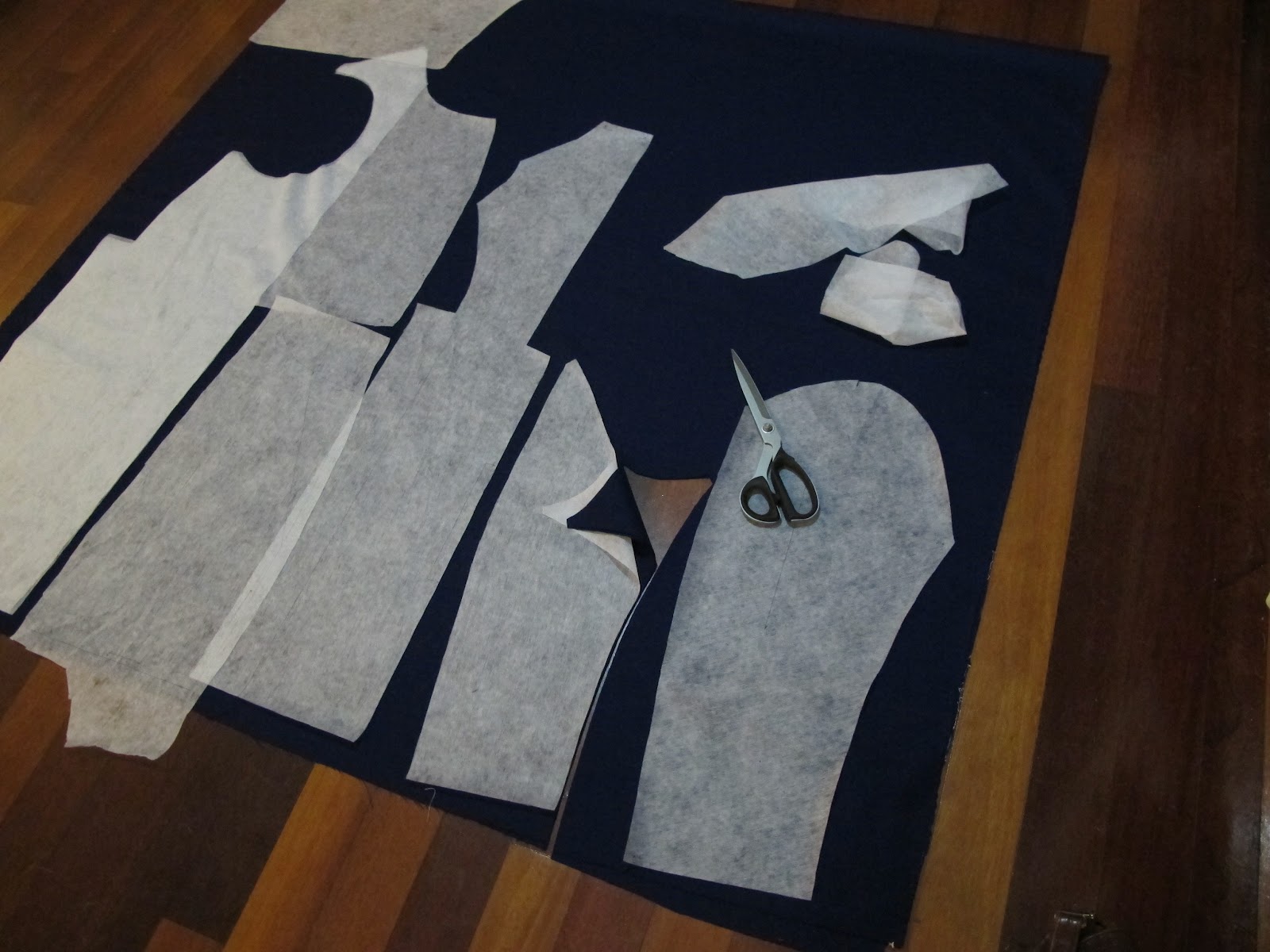
We spent the weekend preparing our Country Wives (new) regency tailcoat toiles - it takes time but is worth it. The sense of satisfaction when you get to make that first cut into your wool is so good, though a bit scary after all the effort that has led up to it.
Tracing out the pattern

Cutting out the pieces

Adjust pattern pieces
Adjusting on dummy set to size before catching husband
Now that we've done our toiles we're moving on to the pad stitching. When you pad stitch you sew INTO but not THROUGH the outer layer. Using a fine silk thread you need to keep the stitches small and close together or you will end up with dimples showing on the outside. The stitches should not go all the way through the outer fabric. This video shows the technique perfectly.


May 16, 2011

A Regency Gentleman's Breeches

A new tailcoat means new breeches. Whilst yellow breeches would go perfectly with the blue wool I've purchased, the store had some lovely sturdy cream canvas that I'll use instead. Because John often gets too hot to wear a tailcoat dancing for four hours plus, I'm using a Scandinavian pattern instead that does not have as a baggy a bottom as Regency-period breeches. As he does not ride a horse, it makes me wonder, did Regency gentlemen ALL wear baggy-bottoms or would a dressmaker have erred on the less-baggy side for a dancing master? I do know that I want to add in pockets, and especially at least one fob pocket in the waistband for a pocketwatch with decorative fob.


I've been reading Norah Waugh's book on men's costume to see when breeches were replaced by pantaloons. I think a man looks so elegant in breeches at a ball.


Breeches were the correct wear with the evening dress coat until c. 1810, and were often worn during the day with tail coats until c. 1830, and always with Court dress. They continued to be worn by the unfashionable until well in the century [...]

Pantaloons were very generally worn until the middle of the nineteenth century ad replaced breeches for formal wear. [...] Until 1817 pantaloons were calf length, and then, they extended to the ankles [...] Straps under the instep kept them taught, but for evening wear the stockings had to be visible. [...]

Trousers appeared very early in the century for informal day wear, and were accepted for informal evening wear from 1817. By 1825 they were in general use, though pantaloons were still considered correct evening wear until the middle of the century. [...]

[...] wider-cut trousers [...] the 'Cossacks' which were inspired by the Czar's visit to London in 1814. They were cut very full and gathered into the waistband and also round the ankles.

May 11, 2011

Men's Regency Tailcoat Workshop, 21-22 May 2011

Aylwen Gardiner-Garden is running a one-off men's regency tailcoat workshop on the 21-22 May 2011 in Canberra, Australia, using the Country Wives brand new Regency men's M-notch and roll collar tailcoat pattern that has just been released in the US and which is already receiving good reviews on its fit, historical accuracy and construction techniques.
Country Wives has just released a brand new Regency men's M-notch and roll collar tailcoat pattern.
This workshop is open to both men and women who have sewing experience, a working sewing machine and time to get the project finished. Participants are welcome to sew the project by hand as was done historically, but may have to finish it in their own time.

If you wish to order a custom-made tailcoat or register interest in a future class, Aylwen is currently taking orders.


Apr 3, 2011

Men's tailcoat from the inside out

I recently explored one of the tailcoats on display at Colonial Williamsburg made by head tailor Mark Hutter. Hopefully the photos will help those with questions on how it is put together.

$0 Web Hosting

Total Page Views