Showing posts with label Regency Men. Show all posts

Nov 3, 2013

Men's Regency Tailcoats

The Regency tailcoat can be made with one of the patterns below and the Kannicks Korner waistcoat pattern is perfect for those wanting historical accuracy.


Aylwen & John Gardiner-Garden, December 2011


Suzi Clarke wrote an excellent article To Cut a Regency Coat where she goes in-depth on the inner workings of the regency tailcoat. Other books that I use regularly for making men's outfits from this period are Federalist & Regency Costume 1790-1819 and The Cut of Men's Clothes 1600-1900. Another book that is often a help, but a bit late for this period is Men's Garments 1830-1900 .
These tailcoats are less tailored than the formal jackets of today, and the construction requires you to work differently to what you expect.

Below are some pictures Aylwen has been collecting over the years to show clients who wish to have a coat custom sewn. These will help you work out what colour wool you want, plus to start thinking about buttons, trims, waistcoat colours and so on.

Aylwen is now taking orders for custom hand-sewn mens hats at http://www.historichats.com


Jul 11, 2013

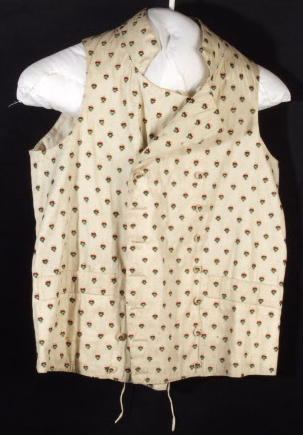
Small boy's waistcoat

Here is something for your viewing while I work on my 1820s dress. I discovered that this early 19th century waistcoat from Brooklyn, US, fitted my 12 year old son Alcuin very well tonight. Below are some close-up pictures - apologies that some images haven't been turned around yet. I especially love the deep pockets on both sides. The front is well padded and you can't tell there are pockets from the inside.


May 6, 2012

Regency Men's Waistcoats

You don't get to see much of the regency gentleman's waistcoat - it is hidden under his tailcoat, which I'm told he was advised to keep on when outdoors or in public. After the flamboyancy of the 18th century the waistcoat fades away during the regency era. On occasion you get to see an embroidered waistcoat, though these are usually re-used from late 18th century waistcoats.
This post has been put together quickly to help those sewing a waistcoat as part of the Regency Costume Challenge. If anyone is using the Rocking Horse Farm waistcoat pattern, an excellent step-by-step blog entry can be read at http://livingwithjane.blogspot.com.au/2011/05/rhf-regency-mens-waistcoat-tutorial.html .


1790-1810 at Chastleton House, Oxfordshire
National Trust Inventory Number 1430632 

1820 at Tyntesfield, North Somerset
National Trust Inventory Number 18754
1780-1790 at Snowshill Wade Costume Collection, Gloucestershire
National Trust Inventory Number 1349016


As quoted from January 1809 Ackerman's Repository:
Fashions for Gentlemen
The prevailing colours are dark brown and bottle green. The coat for evening dress is cut rather long in the waist, and short in the skirts, double breasted, with pointed lappels, corresponding in length to the hip button; the lappels are padded to fall back with the collar, which is made pretty high and stitched narrow, the collar to fall back about an inch and half; deep pockets under the cross flaps; the cuffs round.
The morning dress is made in nearly the same manner, only the pockets are in the plaits of the skirt, and the cuffs are either round or with a flap and three buttons.
The buttons are either gilt basket, or moulds covered with cloth.
Waistcoats are made single breasted, with a small flap about two inches lower than the coat lappel. Breeches are not made so high by two or three inches as they were, and the knee-band extends almost to the calf of the leg, with four buttons at the knee; they are made very tight; and pantaloons are pretty generally ornamented up the sides with brade.

May 24, 2011

Men's Seventeenth & Eighteenth Century Costume: Cut and Fashion


This book is a must if you are sewing men's costumes from these periods. Comes with excellent instructions at the back on drafting a pattern smaller or larger. We used this book during the tailcoat workshop as Simon is a small and the pattern starts at M.

May 16, 2011

Regency Gentleman's Shirts

This is one project that I don't really feel the need to purchase a pattern. There are books with patterns, as well as an excellent one online at http://www.18cnewenglandlife.org/18cnel/shirt.htm and http://www.18cnewenglandlife.org/Hive_project_series%20Shirt.htm . I have a couple of regency shirts in my collection that I will be looking at closer later in the year.


Shirts were worn for day and night wear and were washed a lot. Linen shirts were popular, and many fastened with dorset buttons - one button at the throat and one at each cuff. To make dorset buttons, just take somewhere between one and two yards of heavy thread (buttonhole twist, for instance) and wrap one end around a pencil or knitting needle several times, then thread the other end on a needle, carefully remove the coil from the pencil, and sew buttonhole stitch around the coil until you run out of thread. The last few inches of thread is used to sew several stitches across the back of the button.


A Regency Gentleman's Breeches

A new tailcoat means new breeches. Whilst yellow breeches would go perfectly with the blue wool I've purchased, the store had some lovely sturdy cream canvas that I'll use instead. Because John often gets too hot to wear a tailcoat dancing for four hours plus, I'm using a Scandinavian pattern instead that does not have as a baggy a bottom as Regency-period breeches. As he does not ride a horse, it makes me wonder, did Regency gentlemen ALL wear baggy-bottoms or would a dressmaker have erred on the less-baggy side for a dancing master? I do know that I want to add in pockets, and especially at least one fob pocket in the waistband for a pocketwatch with decorative fob.


I've been reading Norah Waugh's book on men's costume to see when breeches were replaced by pantaloons. I think a man looks so elegant in breeches at a ball.


Breeches were the correct wear with the evening dress coat until c. 1810, and were often worn during the day with tail coats until c. 1830, and always with Court dress. They continued to be worn by the unfashionable until well in the century [...]

Pantaloons were very generally worn until the middle of the nineteenth century ad replaced breeches for formal wear. [...] Until 1817 pantaloons were calf length, and then, they extended to the ankles [...] Straps under the instep kept them taught, but for evening wear the stockings had to be visible. [...]

Trousers appeared very early in the century for informal day wear, and were accepted for informal evening wear from 1817. By 1825 they were in general use, though pantaloons were still considered correct evening wear until the middle of the century. [...]

[...] wider-cut trousers [...] the 'Cossacks' which were inspired by the Czar's visit to London in 1814. They were cut very full and gathered into the waistband and also round the ankles.

May 15, 2011

A Regency Gentleman needs a Cravat

Cravats were developed from Croatian mercenaries honored by Louis XIV in France during the 17th century. It was not until early 19th century that the cravat achieved the height of fashion in France and England.The French called it 'cravate', French for Croat or Croatian. The word "cravat," lost its French final "e" when it crossed to England. Once in England the cravat replaced the neck-high lace collars of Charles I and II. At first it was a straight narrow strip of lace or linen, hanging down from the neck. In the 18th century the jabot took over, the ruffled and embroidered shirt-front billowing up over the opening of the waistcoat almost to conceal the neckcloth, which now buttoned at the back. Then the neckcloth re-established itself over the jabot, covering the shirt-front and evolving into the stock, which grew freer and more voluminous in its proportions as time went on.

An endless variety of cravats appeared, including cravats of tasseled strings, plaid scarves, tufts and bows of ribbon, lace, and embroidered linen all had their staunch adherents. Nearly one hundred different knots were recognised. Collars grew higher at the turn of the 19th century. pointed edges around the chin and cheeks became fashionable. Cravats were wrapped tightly around the neck ending in bows of varying length. Cravats, at this period, were sometimes as much as a foot high, with the points of the collars rising half-way up the face and obliging gentlemen to keep their chins and their heads well up in the air.

It was George "Beau" Brummel who first elevated the cravat into a cult by starching his neckwear, creating novel, intricate knots that might take up to an hour to tie. He was the first to introduce starch into it, insisting that it should be stiffened to the "consistency of fine writing paper". Cravats grew more casual again as the 19th century went on and gradually shrank into smaller bows as the century progressed. Collars became lower, with wide enough gaps between the points to allow the head to move freely enough from side to side.

There were a variety of alternatives to the cravat available to 18th and 19th century men and boys. The most common was the "stock". A cravat was a generally long piece of cloth that would around the neck and tied in front. Stocks were fastened in back by a hook or knot. The stock in front had what to the modern eye looks something like a pre-tied bow tie. Some stocks looked like a wide cravat swathing the neck almost like a poultice. They were not the most comfortable of neckwear. A boy or man wearing one might force the individual to stand or sit upright in a rather stiff positon. The "solitare" appeared in the mid-18th century and was attached in the back to the wig, wrapped around the neck, and brought to a bow in front over a cravat. The "macaronis" appeared in England during the mid-18th century on dandies affecting an Italian-inspired fashion, colouring their cheeks with rouge and wearing diamond-studded pumps, and cravats with huge bows. Those who adopted massive cravats were called the incroyables, meaning the"incredibles". They wore such large cravats that their chins were hidden.
It was the necktie which finally replaced the cravat. It was inexpensive, lasted for ever, and was easy and quick to knot.

To make your own cravat:
  1. Cut 1.5 yards white linen. Keep the selvage edge smooth.
  2. Fold in half lengthwise.
  3. Measure 10 inches on the fold and cut. This will give you an isosceles triangle, 55" x 10". Some prefer not to use a triangle and retain the full rectangular shape.
  4. Hand sew a narrow hem on the slanted edges - the selvage edge is already finished.
  5. Spray starch and iron.


$0 Web Hosting

Total Page Views